
JUST 20
How ordinary people can make our government work again.
It doesn't take everyone. It takes Just 20.
At a glance
- Title
- Just 20
- Author
- Patricia Foster
- Subtitle
- How ordinary people can make our government work again
- Subject
- Civics and government, nonpartisan
- Published
- 2026
- Available
- Amazon
- Website
- WeCanFixCongress.com
Order in the House
Why can't our government solve solvable problems?
Americans pour their attention into presidents, parties, courts and never-ending campaigns. Yet the Constitution hands Congress the central job of turning the nation's problems into durable law. Just 20 argues the country isn't short on politics. It's short on governing.
A retired constitutional attorney, Patricia Foster takes readers inside a corner of government most voters never hear about: the rules that run the U.S. House. Every two years, members elect a Speaker and adopt a Rules Package that decides how legislation is proposed, debated, amended and brought to a vote. That process, she argues, is an overlooked opening for ordinary voters.
Propose. Debate. Amend. Vote.
Her premise is simple. In a closely divided House, a small group of about 20 representatives could hold real leverage over the Speaker and the Rules Package. Voters can ask candidates, before Election Day, to make one commitment: back only a Speaker and rules that give broadly supported legislation a real hearing.
The goal isn't to make Congress agree. It is to make it legislate.
The magic number
Does fixing Congress really mean changing hundreds of members? No. In a closely divided House, roughly twenty representatives can become the majority-makers, with enough leverage over the Speaker vote and the Rules Package on day one to shape how the next two years run.
No new party. No constitutional amendment. No revolution. And no need for Americans to suddenly agree on everything.

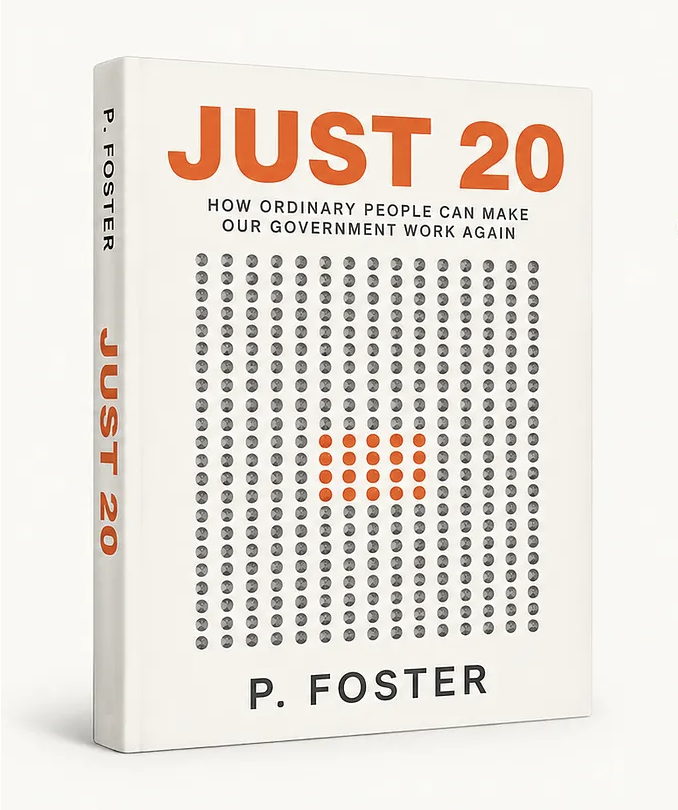
Twenty representatives, highlighted, is all it takes to move the whole House.
Meet the Author

This is civics, not politics.
Patricia Foster spent her career practicing constitutional law and helping Americans find common ground through Beyond Civility. She didn't set out to write a book about Congress. She set out to answer a question millions of people keep asking: why has our government stopped working for us?
Working from outside the Washington establishment, Foster looked past who serves in Congress to the process that governs how it operates. That led her to the House Rules Package, the document adopted at the start of each new Congress that sets how the House does its work. What she found changed how she thought about the power of individual voters.
Her conclusion is deliberately nonpartisan. Restoring Congress's ability to legislate wouldn't require changing anyone's political beliefs. It would take voters expecting their representatives to do the job they were elected to do.
“Foster offers a practical, refreshing answer to the question I hear most about our governmental dysfunction: what can one person do to help? Just 20 offers the hopefulness of The West Wing and the pragmatism of a person who’s spent her life trying to meaningfully improve her community.”
Talking points
Eleven ready interview angles- 01
Why can't Congress solve solvable problems
Some issues have broad public support yet stall over and over. Foster explains why the sticking point is often the process, not a shortage of ideas.
- 02
What if we've been fighting the wrong political fight
Instead of battling over every outcome, voters can demand a legislative process that rewards working through disagreement rather than hardening it.
- 03
Why “Just 20”
The book's majority-maker idea: in a closely divided House, roughly 20 representatives can hold real leverage over the Speaker and the Rules Package on day one.
- 04
The most important vote you've probably never heard about
Every two years the House picks its Speaker and adopts the rules that decide whether legislation gets debated, amended and voted on at all.
- 05
Congress is the quarterback
A plain football analogy for the roles of Congress, the presidency and the courts, and why Congress was built to carry most of the load.
- 06
Four words Congress needs to rediscover
Propose. Debate. Amend. Vote. Lawmakers are not meant to agree. They are meant to absorb disagreement and find what a majority will pass.
- 07
What every voter should ask a congressional candidate
Candidates are applying for a job and voters do the hiring. Foster covers the questions to ask before giving a vote, a dollar or an hour.
- 08
“I'm not political.” Why that's okay
You don't have to become an activist or a policy expert to take part. You can ask for process before politics and expect the basic job to get done.
- 09
How to talk politics with someone who votes differently
Start with real questions about what isn't working, not candidates or parties. The aim is clarity about the problem, not instant agreement.
- 10
What happens after Election Day
Election Day may be the beginning. Organizing the new House and adopting its rules opens a real window for voters and newly elected members.
- 11
Can ordinary Americans really fix Congress
The most hopeful question in the book. Foster argues the power never left the public; it just hasn't been aimed at the point of most leverage.
Get in Touch
Patricia Foster is available for television, radio, print, podcast and digital interviews, plus speaking engagements and civic, business and community conversations.
Fill out the form below to set up an interview.